

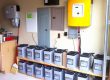
When choosing a solar battery bank there a few things about batteries you need to know. I’m going to help you learn how choose the best solar battery bank for your energy storage needs. All lead acid batteries are comprised of 2 volt cells, three 2 volt cells in a 6 volt battery and six 2 volt cells in a 12 volt battery. Inside the battery each cell is connected in series to achieve the target voltage. It is also helpful to think of the size of each cell inside the battery. The size of the cells is what dictates the ampere hour capacity. For example an 250Ah 8D that weighs 160lbs each cell weighs approximately 26lbs. Not only does the cell dictate the ampere hour capacity it tells you a lot about the overall robustness of the cell. The larger the cell size equals more lead, the more lead you have the more capacity you have. Which in turn equals a longer life span the battery will have especially when compared to batteries of a smaller size. I know that sounds elementary but most take it for granted.
It holds very true when putting batteries in series and parallel in your solar battery bank. For example I want a 48 volt 600Ah battery bank for my home solar battery bank. I know I only need 300Ah, but I also know I can’t go past 50% depth of discharge to get the most out of my battery bank so I need at least 600Ah. I’m told by my solar company/battery expert that I will need 12 12v 8D batteries or I can use 16 6v L-16 batteries. I know I do not want to go anywhere near flooded batteries so I know I want AGM or Gel. I choose to go with 12 8D gels or 16 L-16 AGM batteries. The 8D gels will cost me $425 each and the L-16 AGMs’ will cost me $450. Now I need 12 8Ds’ because I need at least 600Ah at 48 volts. So I need 4 8Ds’ in series to get me to 48 volts (12v x 4 = 48v), followed by two additional strings in parallel (each 8D is rated at 250Ah) to get me over 600ah and that will give me a factory rated capacity of 750 ah (3 x 250Ah = 750Ah) for a cost of $5100. If I choose to go with the 6v L-16 AGMs’ I need 8 in series to get my voltage to 48v (6v x 8 = 48v). Since an L-16 is rated at 415Ah I need an additional string in parallel (2 x 415Ah = 830Ah) which will cost me a total of $7,200. Now remember I said cell size was important and it is so let’s check it out. We estimated the cell size in the 8D at approx. 26 lbs a cell. For the L-16 we take 120 lbs divided by 3 which gives us an approximate weight of 40 lbs a cell. Now the L-16 has larger cells so they should last longer and be more robust. There is some truth to that but the L-16 for one thing is an AGM which gets about half the cycle life if not less than that of a gel battery, so you will be replacing your solar battery bank almost two times before the gel solar battery bank dies. Also 14lbs is not a real significant difference when it comes to lead. Not only is cell size important the amount of cells you have your solar battery bank is just as important. For Example in the 8D string you have 72 cells (6 cells per battery 12 x 6 = 72 cells) in series/parallel. In the L-16 solar battery bank you have 48 (3 cells per battery is 3 x 16 = 48 cells) in series/parallel. If the L-16 was of a gel chemistry it would definitely be worth the extra money because you would have a more robust system with larger cells and less cells in series/parallel. So in this scenario the 8D’s are still the way to go due to they are gels even though they have smaller cells and more of them and not to mention you save some money. Now there is one more solution for your solar battery battery bank and it is the best solution of all. The hands down best solar battery battery bank you could go with is a solar battery bank of individual 2 volt 600Ah gel cells. Each cell weighs in at a 86 lbs, double the size of the L-16 cell and 2 ½ times the size of an 8D cell. You would only need a total of 24 2v cells (24 x 2v = 48v) to get you to your voltage of 48 and would have a true 600Ah battery bank at a cost of $7,200 (each 2 volt gel cell costs $300). On paper the bank of L-16’s and 8D’s have more theoretical Ah’s, but when you factor in the internal resistance and cell size its is significantly less. The 2 volt 600Ah cells have the lowest internal resistance and impedance. The true Ah capacities of the 3 different battery banks are actually all about equal when staring with new batteries. The 2 volt 600Ah cells will also get you a much longer cycling life.
As I said above the amount of cells you have in your solar battery bank is very important and here’s why. The big problem comes in when you put too many batteries in series and parallel. The less cells you have in the string the less internal resistance you have and you also lower the possibility of problems that may happen inside the battery. Over time as the battery ages the internal resistance and impedance will continue to rise, further shortening the Ah capacity. Furthermore when cycling your batteries and you have too many cells in your solar battery bank they tend to get out of family/out of balance more quickly. The batteries will have higher and lower voltages some will be strong and some will be weak, which in turn will lower the Ah capacity. When this happens the entire strings voltage and Ah capacity will start to drop and certain batteries in the bank will become over charged and under charged. This ultimately leads to premature failure of your solar battery bank. The weak cells will continue to degrade the good cells and it can start happening rapidly. A solar battery bank is like a chain, it is only as strong as it weakest link. Using a bank of individual 2 volt cells limits these problems not to mention you can monitor each cell for voltage, heat etc. where as in 12 volt or 6 volt battery you can not test each individual cell. When you factor in the size of the 2 volt cells, their low internal resistance, low impedance and there being only 24 cells total in the string you will have a battery bank that works as advertised while gaining a significant amount of cycling life and Ah capacity versus the bank of 12 volt 8D’s or 6 volt L-16’s.
When choosing your solar energy storage, the solar battery bank that is the most cost effective, user friendly and longest lasting is a 2 volt gel solar battery bank. The competition just has too many weak links, yes Elon that includes you too!
Stay Charged my Friends!
AW





Elon Musk’s lithium-ion batteries are the way of the future! In the next 10 years everyone will be driving a Tesla and we will be using our Tesla’s as a storage bank for our home solar energy systems!A Tesla battery is the best solar battery bank! Wake up and smell the coffee! Elon Musk has more battery knowledge then you will ever have!!!!
Great another Teslarian… Battery Karma you are entitled to your own opinion, but I prefer using energy storage that is cost effective and available now. Maybe Elon has the solution, however I am doubtful it will ever be cost effective or work as advertised. Lithium still has many hurdles to overcome and I don’t see that happening anytime in the near future, gigafactory or no gigafactory. Production isn’t the only problem the Battery Management System (BMS) is much much more of a concern.
Lithium Ion does have some useful applications in solar in a peak shaving scenario where lithium -ion discharges a high amount of energy over a short amount of time usually not longer than 4 hours. BMSs are far from being perfect too.
Yes John I completely agree – Lithium Ion does not do well cycling with a lower discharge over an extended period of time (over 4 hours) such as providing stored solar energy at night. They like to be discharged rapidly, try driving a Tesla on the highway for over 4 hours straight, Haha you can’t the batteries will be dead. 2 volt gel batteries are the best battery for a solar energy storage cycling application. I agree too that complex battery management systems for lithium ion are problematic and far from fail safe and are still susceptible to shutting down or potentially worse, not preventing fires as they are designed too.